Wednesday, January 02, 2008

Jamie Oliver Campaigns For Chicken Welfare

Jamie Oliver
Laying bare the wretched lives of battery reared chickens, television chef Jamie Oliver has turned his celebrity spotlight on poultry and the appalling conditions in which many of them live.
His attempt to stop such cruelty and to encourage supermarkets to invest solely in free range or organic birds is being backed by chef Hugh Fearnley-Whittingstall, who has made his own series of programmes exposing the horrors of battery farming.
The pair hope their combined efforts will draw attention to the suffering of the birds and the poor quality of the meat when chickens are reared cheaply and in cramped conditions.
In some supermarkets, entire chickens can be bought for as little as £2.50, while recent RSPCA figures revealed that just five per cent of the birds in the UK are kept in high welfare conditions.
Oliver, who campaigned against unhealthy school dinners in 2005, examines the poultry industry in his one-off programme Jamie’s Fowl Dinners on Channel 4 on January 11.
In front of invited guests, he will show a series of films and interviews explaining how the birds are killed and their brutal living conditions.
At one stage he examines the 39-day life of a battery reared chicken and says: "It’s disgusting, the smell is awful. Why would anyone want to eat these birds who are walking in their own faeces?"
In Fearnley-Whittingstall’s three part Hugh’s Chicken Run, the chef rears battery chickens in overcrowded conditions in a specially built factory in Axminster in Devon while free range birds are bred nearby.
He tries to ensure that more than 50 per cent of chicken bought and eaten in the town over the space of a week is free range. This includes all curry houses, burger bars and pubs in the area.
Earlier this week, the RSPCA urged shoppers to pay a little extra to ensure their poultry has been bred in decent conditions and called for retailers to sell only higher welfare chicken by 2010.
Of the 855 million chickens reared for their meat in the UK every year, the majority are kept in cramped, dimly-lit spaces.
RSPCA farm animal scientist Dr Marc Cooper said: "If people knew how the average chicken was treated before it ended up as their Sunday roast, they would probably be disgusted.
"Currently, some supermarkets are selling chicken meat for as little as £2 per kilo - this can be less than it costs to produce the bird."
from Telegraph UK

Monday, October 29, 2007

Organic Food Really Is Better For You

Organic Garden
Organic food is healthier than conventional produce and may be better at preventing cancer and heart disease, according to the biggest study of its kind.
In a finding that challenges official advice, researchers have shown that fruit and vegetables contain up to 40 per cent more nutrients if they are grown without chemical fertilisers and pesticides.
The £12 million project also found that organic milk contains 80 per cent more antioxidants -substances which reduce the risk of tumours and life threatening problems.
Organic produce also had higher levels of iron and zinc, vital nutrients lacking in many people's diets.
The findings could help settle the long running debate over the health benefits of organic food.
A spokesman for the Food Standards Agency - which has come under fire for insisting that organic produce is no more healthier than conventional food - said it would review the latest study.
The findings come from Prof Carlo Leifert, an expert in organic food whose four year Newcastle University study is funded by the European Union and food companies.
He said the health benefits were so striking that moving to organic food was the equivalent of eating an extra portion of fruit and vegetables every day.
"If you have just 20 per cent more antioxidants in every portion of vegetables, then it's simply a question of maths - eating four portion of organic fruit and vegetables is the equivalent to eating five portions of traditional fruit and vegetables," he said.
"Having said that, eating five portions of organic is even better still."
His team grew fruit and vegetables and reared cows on organic and non-organic sites on a 725 acre farm near at Newcastle University.
They found that levels of antioxidants in milk from organic cattle were between 50 and 80 per cent higher than conventional milk.
Organic wheat, tomatoes, potatoes, cabbage, onions and lettuce had between 20 and 40 per cent more nutrients.
Although the study has yet to be published in a peer-reviewed journal, Prof Leifert is convinced the findings are sound.
He also believes there is enough evidence for the Food Standards Agency to change its advice on organic food and admits to being puzzled why the agency has not already done so.
"I wonder whether it's more to do with politics," he said.
The research suggests that organic fruit and vegetable is healthier because it uses more natural fertiliser such as clover and manure.
"Plants have evolved to get nutrients from organic matter, " he said.
"They need only a small amount early on in the year, and most in the summer. Yet with chemical fertiliser, they get most soon after planting and very little when they need it most."
The study - which runs for another year - found that milk was more nutritious in the summer, when cattle are grazing fresh grass.
"If you feed a cow on grass you get better milk," he said.
"I suspect that because British cattle have so much grass in their diet that nutrient levels may be higher in conventional UK milk than in some imported organic milk."
The Soil Association, which has been embroiled in a decade long dispute with the FSA over the health benefits of organic food, has welcomed the latest research.
There are few signs that the boom in organic food is ending. Sales are growing by 25 per cent each year and shoppers now spend around £2 billion a year on organic produce.
The reasons why organic food is popular vary. Some shoppers buy it for the taste, others to reduce exposure to chemicals.
Organic meat is popular among shoppers concerned about animal welfare.
The Food Standards Agency has ordered a review into its advice on organic food and health benefits. The results are expected in March.
"Until then the advice remains that there is no evidence that organic food has higher levels of nutrients than conventional food," a spokesman said.
The new study shows that organic milk has 60 to 80 per cent more nutrients in the summer than conventional milk, and 50 to 60 per cent more in the winter.
Organic milk also has higher levels of vitamin E.
Organic cheese can have up to twice as many nutrients than conventional varieties.
Organic tomatoes, wheat, potatoes, cabbage, onions and wheat have 20 to 40 per cent more antioxidants than conventional fruit and vegetables.
Organic spinach and cabbage have been found to have more minerals.
from This Is London

Tuesday, August 28, 2007

Tips For Picking, Storing And Using Tomatoes

Tomato
Summer tomato season is a celebrated but fleeting time of year. For several months each year local produce stands pop up on roadsides and in parking lots, an opportunity for many areas of the country to show off their best locally grown in-season fruits and veggies. For the majority of us, locally-grown tomato season falls during the month of August.
According to tomato.org, more than 1,000 varieties of tomatoes exist. Tomatoes are also the world's most popular fruit. More than 60 million tons of tomatoes are produced per year, 16 million tons more than the second most popular fruit, the banana (apples come in third).
Joe Procacci is a 60-year veteran of the tomato industry, owner of Santa Sweets, Inc., one of the country's largest growers of conventional and organic tomatoes, and is a genuine guru on flavorful tomatoes of all varieties. Procacci also authors a blog called "Tomato Talk," accessible at Santa Sweets
Mr. Procacci started peddling tomatoes during the Great Depression to help his family during trying times. He remembers what winter tomatoes imported from Cuba tasted like, and why they were superior to winter tomatoes in the United States. Since then, he was the first to grow and distribute those tasty little grape tomatoes coast to coast in the United States and Canada. He shares tips today on selecting, storing and preparing the perfect tomato this season, as well as into the winter.
* If you're growing tomatoes in your yard, generally speaking, you should pick them when fully mature on the vine. However, a tomato picked at first sign of color ("breaking" from green to red) and ripened at room temperature should be just as tasty as one left to fully mature on the vine.
* If you're selecting a tomato from your local market, choose your tomato based on when you plan to eat it. Having it for dinner that night? Pick the most ripe, red tomato available with a texture somewhere between soft and firm. If you plan to keep them around until later in the week, pick one that still has some ripening up to do. You'll still get the same great flavor by allowing it to ripen off the vine (on a countertop) for a couple of days.
* Never refrigerate tomatoes, especially those that have not fully ripened. Refrigeration causes the tomato to lose flavor.
* Don't select your tomato based on perfect size or shape. Some of the best tomatoes are creviced or ridged (heirloom tomatoes, for example). The most important features to consider are firmness and color when selecting at the market. However, the best way to select tomatoes is by sampling the flavor. If your seller offers slices to try before buying, which many local farmers' markets do, perform your own taste test.
Joe Procacci is not just a tomato expert, he's a flavor expert. At 80 years old, he continues to travel the globe looking for unusual and tasty tomato varieties to introduce to the United States. Recent journeys have taken him to secret destinations in the Far East, seeking new and innovative tomatoes and other produce.
His research staff developed the UGLYRIPE, the first heirloom style "backyard" tomato that can be grown in the United States year round and shipped nationwide, so that — for the first time ever — tomato lovers in most of the country will finally be able to eat delicious, flavorful tomatoes in the middle of winter beginning this year.
So now that celebrated, but "fleeting" summer tomato season won't be so fleeting anymore. Look for heirloom style tomatoes at your local supermarket long after your local outdoor markets and produce stands have closed for the summer, and look forward to that tasty summer tomato goodness during the dreariest winter days.
from East Bay Newspapers

Thursday, November 30, 2006

Kaiser Embraces Family Farmers

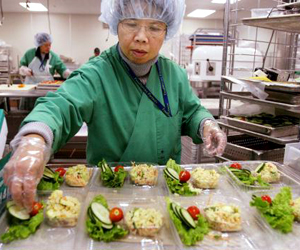
Kaiser PermanenteSAN FRANCISCO — On Wednesday morning, a white-coated food service worker hoisted a box of cherry tomatoes onto a steel table inside a massive commissary that provides almost 6,000 meals a day to 19 Kaiser Permanente medical centers in Northern California.
There was something revolutionary about this produce box. Written on one end was a Southeast Asian farmer's name, Vang Her, who owns a small farm near Fresno. Also scrawled on it were the words "pesticide free."
While farmer's markets have created robust new markets for local farmers selling directly to consumers, finding an efficient way for these small producers to strengthen their economic clout by also supplying institutional food providers has proven virtually impossible.
No longer.
In August, Kaiser Permanente launched a pilot project to purchase fruits and vegetables from small familyfarmers in California. It's created a novel distribution network that provides fresh, and sometimes organic, produce from small farms at roughly the same cost as that from industrial farms. In the process, even in its first few months, the project has lent more stability to the tenuous livelihoods of the small farmers supplying it.
"What Kaiser is showing is that it can be done," said Anya Fernald, director of food service programs for Community Alliance With Family Farmers, a Davis-based nonprofit that's coordinating Kaiser's locally sourced produce program.
"They're absolutely paving the way," she emphasized. "Their demand has built (distribution) pathways that other institutions can use, too." The University of California, San Francisco and Stanford University, among other institutions, have consulted with her group to explore expanding their purchases of local produce, she said.
The idea to use Kaiser's purchasing power to create new markets for small farmers, while improving produce quality, came from an environmental stewardship council run by Kaiser staff.
On that council was Dr. Preston Maring, a physician in the HMO's Oakland medical center. In 2003, he persuaded management to let him bring a farmer's market weekly to the Oakland medical center. It was such a hit that more than 30 farmers' markets are now held weekly at Kaiser medical centers in Northern California.
The success of Kaiser's farmers' markets, which provide patients, staff and the nearby community with easy access to fresh, often pesticide-free produce, got Maring thinking of other possibilities. Knowing the volume of produce purchased by the HMO — some 250 tons annually — he pushed to give local producers a piece of the business.
Just short of four months into the pilot project, Jan Sanders, national nutrition service director in procurement for Kaiser, estimates that local farmers have provided 40 tons of produce to feed patients in the hospital.
With their chicken-salad-on-whole-wheat-bread sandwiches, patients now get a cherry tomato. Sliced apples from a Stockton farmer and grapes from a small farmer in Madera are added to a fruit plate. Earlier this year, patients got locally grown kiwis, cantaloupes, mandarin oranges and strawberries.
Kaiser's new focus on fresh produce dovetails with its 2003 "Thrive" campaign, which encourages lifestyle changes to prevent disease.
"Within Kaiser Permanente, we're promoting 'Thrive,'" said Eirin Hilton, a registered dietitian with Kaiser who helps oversee food service production at the South San Francisco commissary, which is run by a Kaiser contractor, Food Service Partners.
"We have a real theme message here. When people eat well, then they recover better," Hilton added.
"We really are walking our talk," emphasized Sanders. "Our primary goal is prevention, and our primary goal is to improve the health of our patients and our community."
A portion of the HMO's offerings still consists of prepared foods like pancakes, sausages and Danish pastry. But their presence also reflects patients' preferences, said Hilton. Had the current emphasis on fresh produce begun several years back, the initiative might have faltered, she said.
"There's a whole momentum changing with food and health," Hilton noted. "In the past, if we'd try to do this, we would have had major patient dissatisfaction."
But the growing interest in improving Americans' health through better diets is gratifying to her. "It's a health-care phenomenon that's given us humble dietitians a lot more recognition than we've ever had before," Hilton said.
The role Kaiser is playing in bolstering family farming operations is also a source of pride for Sanders and Hilton. The number of family-run farms also keeps declining statewide, said Fernald.
"These are small farmers that are supporting their families on 100 acres," Hilton said. Farmers from ethnic groups, such as the Hmong — tens of thousands of whom fled to California from Southeast Asia after the Vietnam War ended — get priority for supplying the program, although it's not exclusively minority-supplied, emphasized Fernald, with the family farmers' alliance.
She said 15 family-run farms contribute to the project, and she expects 30 by next summer. Kaiser now spends about $10,000 a month on locally sourced produce, and according to a financial analysis, is only spending $400 more a month than it would by purchasing from a distributor supplied by large farms, Fernald said.
And San Vang, a Fresno farmer who grows cherry tomatoes on his 2-acre plot, is now earning more per box by selling into the Kaiser program, as he has cut the cost of the middleman.
The new market for fresh produce — which will expand to other Kaiser facilities if the pilot is deemed a success — also helped at least one Hmong family salvage its crop this fall, Fernald said.
In October, a packing house in Fresno told nine Hmong families who each had farms growing cherry tomatoes that it wouldn't need their produce any longer, she said.
"Several families pulled out their plants," Fernald, even though they still bore tomatoes. "They just didn't have any other option. They couldn't establish new connections, because it was too late in the season."
But at least one of the families, she said, learned of Kaiser's locally grown-produce project, and has been able to sell its tomatoes into it for the past three months.
"No one's becoming a millionaire off of this," Fernald added. "It's that little edge that helps keep a farmer in business."
And as cherry tomato season in California winds down, Kaiser will turn to Mexico for its supply this winter. Eventually, Fernald hopes to even persuade the HMO to forgo even those markets.
"Go seasonal, like using persimmons on salads in the winter, instead of cherry tomatoes," Fernald said. Sweet potato sticks and dried fruit are another option, she said. Diners, she added, enjoy the variety and novelty.
"If we're able to encourage creativity, we can open up new opportunities for farmers," Fernald said.
But, she recognized, that type of change may take time. Until then, she's content moving "one step at a time."
from The San Mateo County Times

Wednesday, November 29, 2006

Organic Lawn and Garden Product Sales To Reach $670 Million By 2011

Organic LawnEmerging as a 6% sprout in the overall U.S. lawn and garden market, the latest market research from Packaged Facts shows sales of organic fertilizers and growth media (F/GM)—and to a lesser degree organic pesticides—blossoming over the next five years. With the market currently worth $360 million, Trends in Organic Lawn & Garden Products projects that the market will sustain double digit growth for each of the next five years, firmly rooting itself as a viable niche market at $670 million in 2011.
The new Packaged Facts report sees significant pressure building at the grassroots level to upend the status quo of synthetic or conventional supplies, which make up the bulk of the current $6 billion U.S. lawn and garden market. Just as other “green” or eco-friendly products are vigorously growing into other markets, lawn and garden organics are quickly becoming a viable alternative.
“Much of the grassroots success is coming from baby boomers, who through sheer force of their demographic size have the ability to shift the status quo in favor of an environmental utopia,” said Don Montuori, the publisher of Packaged Facts. “The fact that organic lawn and garden products fulfill this goal and that boomers are entering the traditional prime gardening years, speaks volumes to the potential for an organic groundswell.”
Currently, a majority of the marketers involved in organic L&G are primarily engaged in selling to the commercial agricultural and horticultural markets rather than to the consumer lawn and garden market. Yet as economic and environmental concerns continue to escalate, consumer interest at the home level is expected to increase as scientific advances continue to improve organic options.
from Press Release

Wednesday, September 06, 2006

Common Ground Marks 34th Year Of Organic Living

Common GroundPALO ALTO, CALIFORNIA - Whether it's gardening classes, tools or supplies, Common Ground Organic Garden Supply and Education Center in Palo Alto has filled the bill for gardeners and mini-farmers for 34 years.
John Jeavons is executive director and a founder of Ecology Action of the Midpeninsula, a nonprofit environmental research and education organization that started in Palo Alto and later moved to Willits (Mendocino County).
Common Ground is one of Ecology Action's projects.
Ecology Action began in 1970 when a group of Palo Alto residents got together to start a recycling program in the city, said Patricia Becker, manager of the Common Ground center.
After the city took over the recycling program, Becker said, Ecology Action started four more projects: a bicycle workshop that also promoted bicycle lanes in Palo Alto, the Common Ground education center, the Common Ground supply center and the half-acre Common Ground research, demonstration and biointensive garden at Syntex Corp. in Palo Alto.
The bicycle workshop evolved into the independent Wheelsmith bicycle repair shop and then into Wheelsmith Fabrications Inc., a maker of lightweight bicycle wheels that moved to Big Timber, Mont.
The garden was discontinued in 1981, a year before Ecology Action moved to Willits, where it has demonstration gardens and promotes biointensive mini-farming throughout the world.
Using organic and sustainable techniques developed by the late English horticulturist Alan Chadwick, biointensive practices emphasize ways to grow enough food for a family of four on much less land than required by conventional agriculture.
Those techniques stress seven factors used in combination:
-- Double-dug raised beds.
-- Composting.
-- Intensive planting.
-- Companion planting -- plants that do well together or that attract or repel insects.
-- Carbon farming -- feed and grain crops such as corn, wheat, millet, amaranth and oats that produce a large number of calories and make good compost.
-- Calorie farming -- high-calorie crops such as potatoes, sweet potatoes and parsnips.
-- Open-pollinated seeds rather than hybrids.
Jeavons describes these techniques in his "How to Grow More Vegetables (and Fruits, Nuts, Berries, Grains and Other Crops) Than You Ever Thought Possible on Less Land Than You Can Imagine." Originally written in 1974, the book will come out in a seventh edition from Ten Speed Press this month.
Becker worked as Common Ground's class coordinator for four years. At that time, the center was at 225 El Camino Real. She became the center's manager in 2000 and supervised its move to 559 College Ave. in September 2001.
Originally from Pittsburgh, Becker became seriously interested in macrobiotics in her late 20s. Macrobiotics is a dietary approach that stresses whole grains, fresh vegetables, beans and other "seasonal, local and organic" foods, she said.
She came to California in 1984 to work as a macrobiotic chef in a Hillsborough couple's home. Since then, her career has taken her to such places as Harbin Hot Springs in Lake County and Hidden Villa Organic Farm and Wilderness Preserve in Los Altos Hills.
She describes Common Ground as follows: "It's community; it's gardening; it's education."
"We want to have what people need" for gardening. She also wants it to carry locally made items such as jams, honey, soaps and crafts.
In addition, the center sells high-quality garden tools. It has a lending library for members (basic membership costs $25 a year) and a reference library for in-store reading.
Customers can buy more than 500 varieties of seeds in jars or packets, vegetable and herb seedlings, native plants, organic fertilizers and soil conditioners, and natural pest control products.
Common Ground also offers classes ranging from an introduction to permaculture to composting techniques and designing sustainable landscapes. A complete schedule is at commongroundinpaloalto.org.
Harking back to its roots, the center plans to develop a garden on land offered by the Palo Alto Christian Reformed Church on Arastradero Road, which will be used to demonstrate intensive gardening methods and to raise seedlings to sell at the center. It also will be an outdoor classroom.
Becker expects planting to start by the end of the year. The center is still looking for a sponsor to provide funds to hire a full- or three-quarter-time gardener, she said.
from The San Francisco Chronicle

Tuesday, September 05, 2006

The BIG Organic Question?

ProduceHead to the grocery store these days, and almost everything on your shopping list has an organic equivalent. You can buy organic cereal, soup, chicken, cheese, and yes, even organic burgers.
Organic foods, including produce, meats, grains, and ingredients used to make various products, must be grown without the use of potentially harmful pesticides, chemical fertilizers, antibiotics, or growth hormones. We get healthier food when we eat organic. There are studies that suggest organic produce has higher nutrient levels and studies connecting health risks to the hormones and antibiotics” used in conventional animal products. Some nutritionists argue the differences are negligible, but eating an organic diet is greater than the sum of its parts, because like a savings account, the benefits accumulate over time.
Still, even with the introduction of lower-cost supermarket brands, conventional foods have one irresistibly attractive quality: price. Organic fruits and vegetables typically cost 10 to 30 percent more, and frozen produce, meats, eggs, milk, and processed foods like cereals, soups, and salad dressings run 50 to 100 percent more. So should a runner always shell out the extra cash for the healthier stuff?
Smart Shopping
There are clear differences among fruits and vegetables in their loads of pesticides. Some make sense to buy organic; others don’t matter as much By eating the organic versions of the dirty dozen, you can reduce your exposure to contaminants by 90 percent. If your budget or options are limited, don’t feel bad forgoing organic food. The reason for the difference in pesticide levels varies from crop to crop; some foods require more pesticides than others, and some have their own protective shell, like the skin of a mango or a banana peel. And buy conventional, too, if you can’t find or afford organic produce. Eating fruits and vegetables for the multiple nutrients they provide is the more important thing. The bottom line is that some foods expose you to more contaminants than others. If you can afford to buy organic all the time, it’s better for you-and the planet.
Organic Shopping Guide
What does the label mean? The word organic can be used for both domestic and imported foods. Here’s what the other labels mean:
100 per cent Organic: All ingredients must be organic
Organic: Guarantees 95 per cent of the ingredients are organic
Made with organic ingredients: At least 70 per cent of the contents are organic
from Afternoon Dispatch & Courier